The heart is the most important part of the circulatory system;it has for 'chambers', which pump blood in and out of the organ; these chambers are separated into two groups- the left and right atrium (the two lower chambers) and the left and right ventricle (the two lower chambers); the left atrium receives oxygenated blood, through the pulmonary vein, from the lungs, which is then passed on to the left ventricle and out through the aorta...
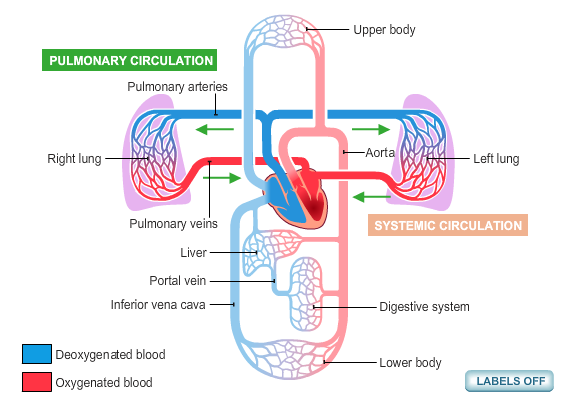
New Health Advisor- Circulatory System
The oxygenated blood is then transported to the upper and lower body areas, the digestive system and the liver (it is not part of the digestive system!), where the oxygen is slowly taken out of the blood; by the time the blood reaches the right side of the heart, there will be no more oxygen left and the blood is now called deoxygenated blood. This deoxygenated blood is taken to the right atrium, again, being passed on to the right ventricle, before being transported to both lungs, where they 'collect' oxygen, becoming oxygenated again and arrive back at the left side of the heart (just in time for tea!), where the whole process restarts.
The Eye
The eye is a complex organ and is made up of various tissues and muscles; it is protected by multiple layers of tissue, such as the conjunctiva and the cornea.

Bitesize- Eye Diagram
As the eye is very hard to describe, without having to right a an entire essay, here are the definitions of the words in the diagram-
Iris- This is a circular piece of tissue, which changes shape due to amount of light trying to enter the eye, the iris's circular muscles (think circumference) will contract, making the pupil (the middle part of the eye) look small, when there is too much light getting in, and ,in low light, the iris's radial muscles (think radius) will contract, making the pupil look big; this is called the iris reflex.
Conjunctiva and Cornea- These are the eye's way of protecting and keeping inside clean; they keep dust and dirt out of the eye and fluid inside the eye. The cornea also helps the lens in bending light rays.
Lens- This is the most important part of the eye, next to the retina of course, it bends the light rays as they enter and the image of an object is flipped upside down and is then bounced on the retina to make it look the right way, it's very confusing.
Optic Nerve- This is a nerve, which connects via the brain, so that the brain can control the eye and tell it to blink, look around, focus and , basically, just boss it around.
Ciliary Muscle and Suspensory Ligament- These two change the shape of the lens depending on how far away or near an object is, that the eye is focusing on; if the object is near, the ciliary muscle will contract and the suspensory ligament loosen, making the lens bulge, and when the object is far away, the ciliary muscles will relax and the suspensory ligaments tighten, making the lens thin; this is called accommodation.
Aqueous and Vitreous Humor- These two are not on the diagram, but are worth knowing if you want a C; aqueous humor is the fluid in between the lens and cornea, it has special salts, which nourish the lens; vitreous humor is the fluid in between the retina and lens, so I'm guessing it has the same function as aqueous humor, to the retina?
Enzymes
Enzymes are catalyst, which is a substance that speeds up the rate of chemical reactions, without getting denatured (not killed!) itself.
There are lots of different types of enzymes (or catalysts), in different parts of the body, that breaks down different substances, for different reasons. Here are the main four enzymes that are definitely worth knowing for foundation-
Amylase breaks down starch into maltose
Maltase breaks down maltose into into glucose
Protease breaks down protein into amino acids (there are different enzymes that break down proteins into 20 different amino acids)
Lipase breaks down lipids into fatty acids and glycerol

Crossroads- Enzyme Pyramid
Most amylase enzymes are found in saliva, near and in the mouth, which is why they are called digestive enzymes, because they help to break down food, in the mouth or swallowed, for easy digestion.
Other enzymes, such as pepsin, which is found in the stomach and breaks down proteins, and trypsin, which is found in the liver, but produced by the pancreas and breaks down proteins, are more examples of digestive enzymes.
A catylase is an enzyme found in all living tissues, which catylases (speeds up) the break down of hydrogen peroxide into water and oxygen.
Enzymes (e.g., amylase) break down substrate (e.g., starch) into products (e.g., maltose).
As well as breaking down their substrates into products, enzymes can also piece two separate substances together to form whole particles or substances.
Thanks for reading so far! This page will be updated as regularly as possible and tweeted on twitter ( https://twitter.com/Panther295 ), so if you like this and want to read more, keep an eye out on this website, but please leave your eye in, because it is attached to your brain (via the optic nerve), remember?

No comments:
Post a Comment